BOS returns 46 orangutans to the wild
BOS Foundation returns 46 orangutans to the wild
6 September 2009
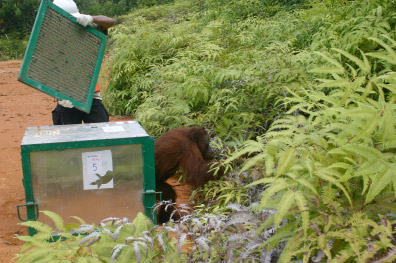 The Borneo Orangutan Survival Foundation (BOSF) has successfully released 46 orangutans back into the wild. These orangutans had been rescued from starvation, injury, illness or captivity by BOSF’s Nyaru Menteng Rescue and Reintroduction Project, and have now been returned to a tropical rainforest in the remote heart of Borneo, where they should be safe from human persecution and the devastation of their habitat by the palm oil industry.
There are around 35,000 orangutans remaining in the wild in Borneo, and all are in danger from illegal logging, wildfires and hunting, but the biggest threat by far today is the conversion of forest to oil palm plantations. Palm oil is used in a huge range of products, including foods, soaps, cosmetics and machine lubricants, and – more recently – as an alternative source of fuel. Increased demand for this kind of ‘biofuel’ has led to a huge expansion of oil palm plantations across Borneo, and thus widespread clearance of tropical rainforest, home to thousands of orangutans. Most orangutans that lose their habitat die of starvation, or get shot when they’re forced to raid the newly-planted palm trees, or are captured when they have no option but to venture into villages to find food. But those who are fortunate enough to be rescued are taken to the Nyaru Menteng Rescue and Reintroduction Centre, where they are cared for and brought back to health by the Centre’s dedicated staff, before being released back to the wild.
The Nyaru Menteng Rescue and Reintroduction Centre is the largest primate rescue project in the world. Founded in 1999 by Lone Dr?scher Nielsen, it has rescued over 1,000 orangutans. Around 600 of these are young orphans whose mothers were killed when their rainforest habitat was destroyed to make way for oil palm plantations. These orphans will not be released until they’ve been completely rehabilitated – a process which can take up to 10 or 12 years to complete. The 46 which have just been released were not at Nyaru Menteng for rehabilitation – these were fully independent individuals when rescued and were kept at the Centre to recuperate, and to undergo medical treatment and observation until they were deemed fit enough to live in the wild again. Finding a safe place to release them has, however, been difficult, because nearly all suitable habitat for orangutans in Borneo is being illegally logged, converted to plantations or is already full with wild orangutans.
 In 2007, a large area of almost pristine forest in the upper Barito region of Central Kalimantan, within the Heart of Borneo, was identified as suitable for orangutan reintroduction using a combination of satellite images, helicopter flyovers and ground surveys. Here there are several thousand hectares of primary lowland rainforest, in lush green valleys and mountain ridges, divided by large rivers flowing through gorges and over rapids. The area has plenty of available food for orangutans, as evidenced by ground surveys, yet only supports a small wild orangutan population, probably owing to a combination of historical hunting by indigenous hunter-gatherer tribes (which has now ceased) and the wide rivers and mountain ridges acting as barriers against the species’ dispersal. Sixty-one orangutans were released here in 2007 and 2008; and in 2009 another 20,000 hectares in a series of connected valleys was identified as the location for the current releases.
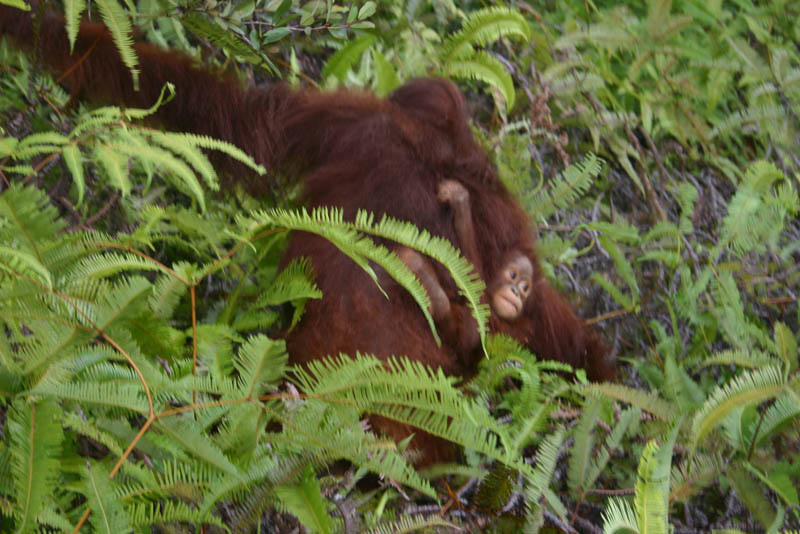
The release process started back in the Centre, firstly identifying those amongst the rescued adult and sub-adult animals which were sufficiently independent to be released, and then making sure that they were healthy and not carrying any disease that could spread through the new population. The 46 orangutans chosen consisted of nine flanged adult males; six unflanged adult males; eleven adult females; seven adolescent males; twelve adolescent females and one female infant (with her mother).
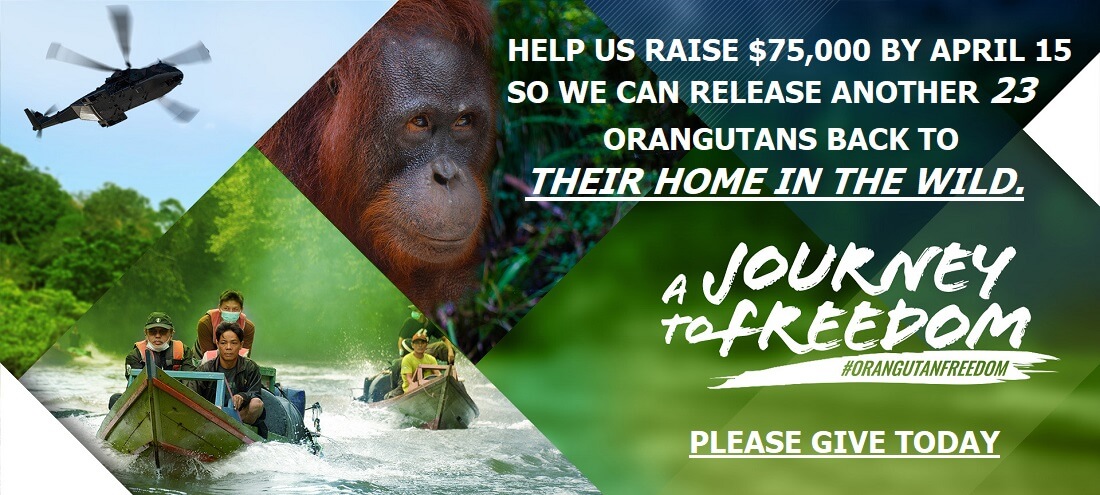
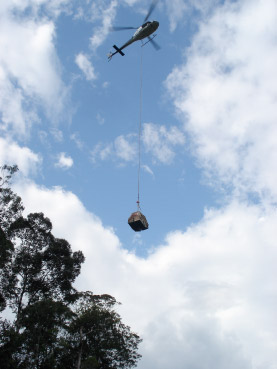
 Those orangutans were then flown to a holding camp near to the release site, ready for their final journey back to the wild. BOS veterinarians were on hand throughout the entire operation to make sure that the apes didn’t suffer too much from the stresses of the journey and were released in a healthy state. Helicopters were used for the final stage of the release. The orangutans were sedated and placed in individual cages, then flown – six or seven to a sling, suspended 100 feet below the helicopter – to the release points, where a team on the ground waited for the helicopter’s arrival and then opened the cages. Six separate release points were chosen, spaced 2 km apart to ensure that the influx of orangutans wouldn’t exceed the forest’s carrying capacity.
The field team were based at the camp of the Project Barito Ulu research project, one hour downriver from the first release point, and maintained communication with the holding camp team by satellite phone and HF radio. The whole operation took 18 days, with the releases taking place over a six day period from August 17th to 22nd. Immediately post-release, a Nyaru Menteng socialisation team visited nearby villages to raise awareness about the orangutans, Nyaru Menteng’s activities and the release operation; and to encourage future feedback from the local community which will help with future monitoring. A monitoring team is already in place from previous releases, which carries out research to assess the location and health of released orangutans.
This release location is also suitable for releasing rehabilitant orangutans. Nyaru Menteng currently has 200 individuals ready to return to the wild, and preparations for their reintroduction are underway. Requirements include leasing helicopters, ensuring long-term security of the site, and providing post-release care and monitoring for the released orangutans.