Behaviour

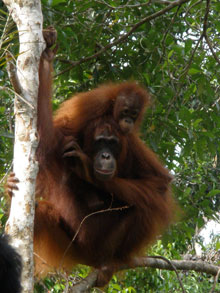
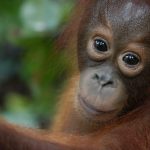
The orangutan is the only strictly arboreal ape and is actually the largest tree-living mammal in the world. Although the rest of the apes do climb and build sleeping nests in the trees, they are primarily terrestrial (spending their lives on the ground). Even the hair colour of the orangutan, a bright reddish brown, is unique in the ape world.

The orangutan has the most remarkable ability to travel through the forest treetops. Each night they will build nests out of leaves and branches in the very tops of the trees – sometimes as much as 100 feet above the ground.

Almost all of the food they eat grows in the treetops and the frequent rains fill the leaves, supplying them with drinking water. When water is difficult to find, they chew leaves to make a sponge to soak up the droplets in tree cavities. However when it rains very hard, the orangutan makes an umbrella for himself out of big leaves.

Some might say orangutans have four hands instead of two hands and two feet. These appendages make them graceful and agile while climbing through the trees but makes walking on the ground somewhat slow and awkward. This is why an orangutan is at a great disadvantage on the ground, and an orangutan rarely comes down from the treetops.

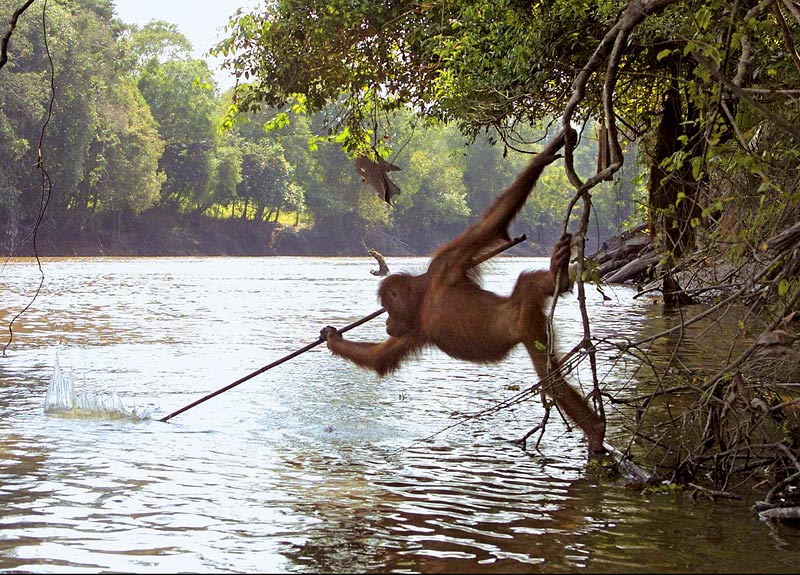
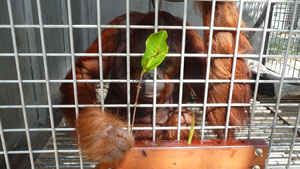
Many people are familiar with the studies that have shown chimpanzees using tools, such as termite-fishing sticks. Recent studies show that some populations of orangutans also fashion tools to aid in the difficult task of foraging for food. Orangutans have even been observed using sticks to catch fishing lines.
           

Orangutans emit a variety of calls and vocalisation including the long call of the males to attract females or discourage other males and the kiss-squeak, often made when observers get too close. To hear these and other calls, visit the Zurich's University Anthropological Institute & Museum here.

For recent news articles on orangutan behaviour, click here.

Back to:

Orangutan Facts

Biology

Diet

Photos: Sue Floyed, Fleur Butcher
 
Latest BOS News and Information
Activists, businesses work to save the orangutan

15 July 2010
Why should we protect the orangutan? It is a frequently asked question when lay-people, including businesspeople, discuss the need to protect orangutans, Asia's only great ape, which is greatly endangered. Read Article »


The ape dictionary

23 June 2010
If an orangutan blows a raspberry, smacks you on the side of your body or gives you a nip on the arm, don't worry. Read Article »


Companies coy over palm oil use

21 June 2010
Some New Zealand food companies are being slippery about whether they use palm oil, according to a Green Party survey.

Read Article »


Freedom costs as little as $58

6 June 2010
Borneo Orangutan Survival (BOS) Australia and its Indonesian counterpart have secured a 112,000 hectare site in Kalimantan, Indonesia for the release of rehabilitated orangutans.

Read Article »


Indonesia pledges two-year deforestation moratorium

27 May 2010
Indonesia will introduce a two-year moratorium on deforestation to help tackle climate change, the country's president has said. Read Article »


Australia urged to ban illegal timber imports

28 May 2010
United States congressman Earl Blumenauer has called on the Australian Government to legislate to ban illegal timber imports into Australia.

Read Article »


Indonesia committed to rainforests protection despite financial constraints

27 May 2010
Cash-strapped Indonesia remains committed to protection of its rainforests as part of the global initiative to reduce emissions from deforestation and forest degradation (REDD) Plus scheme, President Susilo Bambang Yudhoyono says.

Read Article »


Indonesia to honour palm oil contracts despite forest protection

27 May 2010
Indonesia will honor palm oil companies' existing contract despite its pledge to suspend new concessions to clear the nation's natural forests and peat lands for two years, President Susilo Bambang Yudhoyono says.

Read Article »

BOS Newsletter
Keep up with the latest from BOS Australia.
First Name:
State:
Email: