Don’t hurt my baby!
Pregnant orang-utan protectively hugs her daughter as ruthless Borneo bounty hunters move in for the kill
Daily Mail: Richard Shears: 27 January 2012
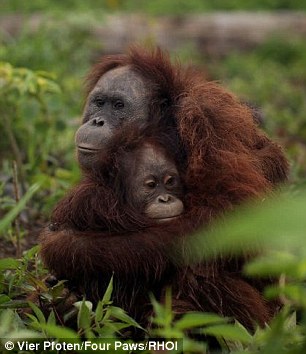 As bounty hunters with bush knives entrapped them in a circle and moved in for the kill, the only thing this mother orang-utan could think to do was to wrap a giant protective arm around her daughter.
The pair seemed to be facing a certain death as a gang of hunters surrounded them in Borneo, keen to cash in on the palm oil plantations’ bid to be rid of the animals.
But, happily, a team from the British-based international animal rescue group Four Paws arrived in time to stop the slaughter and saved their lives.
The pregnant mother and daughter were captured and moved to a remote and safe area of the rainforest and released back into the wild – but not before the mother was equipped with a radio device so she and her young can be tracked to ensure they remain safe.
‘Our arrival could not have been more timely,’ said Dr Signe Preuschoft, a Four Paws primate expert.
Mother and daughter were captured and moved to a remote and safe area of the rainforest and released back into the wild – but not before the mother was equipped with a radio device so she and her young can be tracked to ensure they remain safe.
‘Our arrival could not have been more timely,’ said Dr Signe Preuschoft, a Four Paws primate expert.
‘A few minutes later and the orang-utans could have been dead.
‘We discovered a gang of young men surrounding them and both victims were clearly petrified.
‘The gang meanwhile were jubilant in anticipation of their rewards for catching and killing the animals. These massacres must not be allowed to continue.’
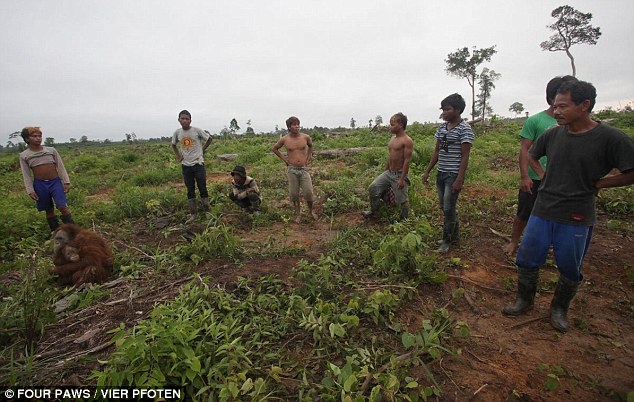 Rescue: When the animal rescue group found the “clearly petrified” mother and baby they discovered a gang of young men who were looking to cash in on the palm oil companies’ offer of £70 per orang-utan
Before the rescue, a Four Paws team had scoured the area on the Indonesian side of Borneo, which is shared with Malaysia, but found no other orang-utans which had survived an earlier slaughter.
Deforestation has dramatically reduced their habitat and their numbers have dropped from 250,000 a few decades ago to only 50,000 in the wild.
And while the loss of their habitat by logging companies has created a major threat to their existence, a more brutal form of reducing their numbers has emerged in recent years – direct slaughter.
Palm oil is used in hundreds of products from chocolate to oven chips, but the demand for buying it at a low price has resulted in significant deforestation as habitats are being destroyed to make way for plantations.
Some palm oil companies see orang-utans as pests, a threat to their lucrative business, and have placed a bounty on their heads.
Company executives are reported to be offering up to £70 to employees for each orang-utan killed on the palm oil plantations.
Fresh start: The apes were released back to rapidly decreasing wilderness elsewhere in Indonesia by the charity group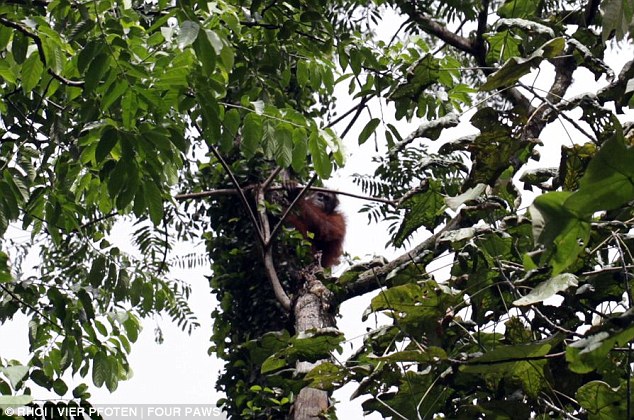
While such stories were at first denied, proof of the slaughter emerged last September when graves and bones were found by investigators.
‘Killing of orang-utans is illegal in Indonesia but the law is lacking enforcement,’ said a British Four Paws spokesman.
‘Before November last year only two low-level arrests had ever been made.
‘But in the last two months 10 more arrests have taken place including the arrest of the senior manager of the plantation where the worst graves have been found.’
In an equally tragic scenario, babies left alive after adult orang-utans have been slaughtered have been put up for sale in the pet trade by hunters.
When traumatised babies are found by Four Paws and other animal rescue teams they are taken to a sanctuary and taught skills they will need in order to return to the wild.