
Human laughter echoes chimp chuckles
Human Laughter Echoes Chimp Chuckles
Wired News: Lizzie Buchen : 6 June 2009
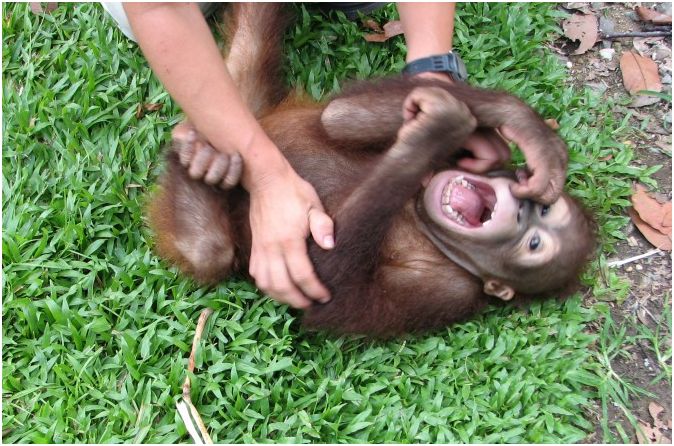
Humans aren’t the only ones who like it in the armpit. Our fellow great apes - orangutans, chimps, bonobos and gorillas - also squeal in response to tickling, and new research shows this behavior may be the evolutionary root of human laughter.
Scientists have known that great apes vocalize when tickled at least since Charles Darwin’s time. But it was unclear whether these sounds were actually related to human laughter. Now, researchers at the University of Hannover in Germany have concluded that laughter has been evolving in primates over the last 10 to 16 million years, since at least the last common ancestor of humans and modern great apes.
“The vocalizations of non-human primates were presumed to be panting and thus dissimilar to human laughter,” said psychologist and lead author Maria Davila Ross.
In addition to acoustic differences, humans and other primates produce the sounds in different ways: humans laugh primarily on the exhale, while our fellow primates’ tickle-induced pants flow in and out. These distinctions made it difficult to figure out whether laughter originated before humans, Davila Ross said.
Laughter is a key component of social interaction in humans. Humans are 30 times more likely to laugh when in the company of other humans than not, and tickling is inherently social - no animal is capable of tickling itself. Understanding the origins of laughter can also lend insight to the evolution of language, as both behaviors involve breath control and vocal cord vibrations.
“Laughter serves as an emotional contagion,” said biologist Jared Taglialatela at Clayton Sate University. “It serves as a way of getting everyone on the same page. Secondly, it serves as a way for individuals to inform their social partners about their intentions, as well as provide information and feedback about their own emotional state.”
In other words, the laughter continuously tells an animal’s playmates that he is happy and merely fooling around, with no intention of picking a fight. This type of play builds social bonds in many mammals, including other primates and mammals like dogs and rats, which are also thought to emit sounds while being tickled.
To explore the origins of laughter, Davila Ross and her colleagues tickled infant and juvenile humans, orangutans, chimps, gorillas and bonobos - all great apes - in the armpits or on the palms, feet or necks. These areas are thought to be most ticklish because they are either rarely touched, or are usually in contact with a broad surface. Davila Ross recorded the baby animals as they hooted and squirmed.
While the acoustics were different between all species, Davila Ross found that when she mapped the variability onto a phylogenetic tree, it lined up with the primates’ well-established genetic relationships. The closely related chimpanzees and bonobos, for example, had laughs that were more similar to each other’s than to those of gorillas and orangutans, their more distant cousins. The laughter of human babies showed the greatest aberration from that of all other apes, although it was more similar to chimps and bonobos, which are closer on the evolutionary tree.
The features of human laughter that most distinguished it from that of the other apes were the regular vibration of the vocal cords (producing the loud guffaws and ‘ha has’) and dominance of exhaling, both of which are dependent on superior breath control. But even these elements could have originated in the other great apes. Davila Ross discovered that orangutans and gorillas were both able to extend their exhalations to three to four times longer than a normal breath, and that bonobo laughter involved vibrations of the vocal cords. Previous work also found vocal cord vibrations during chimp laughter.
“It is not simply that there are characteristics that arose de novo in humans,” said Taglialatela. “Rather, there is continuity in what apes do, and in what humans do.”
Davila Ross says the differences between these laughs might be due to anatomical differences, as a side-product of speech evolution, for example. But there may also be functional explanations. Unlike other apes, humans can laugh without any contact or threat of contact, as their ôplayö is often cognitive or linguistic. Because a playmate need not be in reach of an armpit, laughter may require an extra boost from the lungs and vocal cords to reach a companion’s ears.
Citation: Davila Ross et al., Reconstructing the Evolution of Laughter in Great Apes and Humans, Current Biology, Vol 19, Issue 11 (2009).
Images: Miriam Wessels, University of Veterinary Medicine/Hannover