Rehabilitation process
The Rehabilitation Process
The method of reintroduction at Nyaru Menteng tries to imitate, as closely as possible, the life the orangutans would have had, were they still with their mothers in the forest.
Quarantine
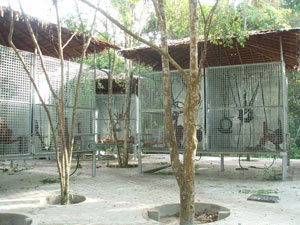 All new orangutan arrivals at Nyaru Menteng need a medical check up and a short time in quarantine. The new arrivals are tested for Hepatitis A, B and C, Tuberculosis, Herpes and HIV. Hair, nail and blood samples are taken for DNA tests and are placed on record. They will also go through a worming treatment and measurements are taken of their weight and body size. Finally the new arrivals are photographed.
Following this and assuming test results are negative, the orangutans are moved to a level of reintroduction suited to their needs and personal character.
The method takes into account that orangutans are just as individual as humans and their backgrounds differ tremendously. A two year old orangutan, who has only spent a week in captivity in a cage with little physical human contact, is still wild and could successfully be moved directly to the release site after quarantine whereas a six or seven year old who has been in captivity for most of his/her life will need a much longer transition period before being moved to a release site.
Baby-school
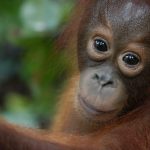
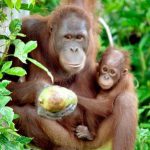
.jpg) Baby-school is provided for baby orangutans that are less than 3 years old. Some older orangutans who have gone through traumatic experiences and/or have physical disabilities may also be placed here for a short time.
Baby-school is provided for baby orangutans that are less than 3 years old. Some older orangutans who have gone through traumatic experiences and/or have physical disabilities may also be placed here for a short time.
The baby orangutans spend most of their days in the forest with their carer or baby-sitter who is usually a woman from the Dayak tribe.
The baby orangutans are not only trained to climb trees but are also looked after with all the care their own mother would provide them in the wild.
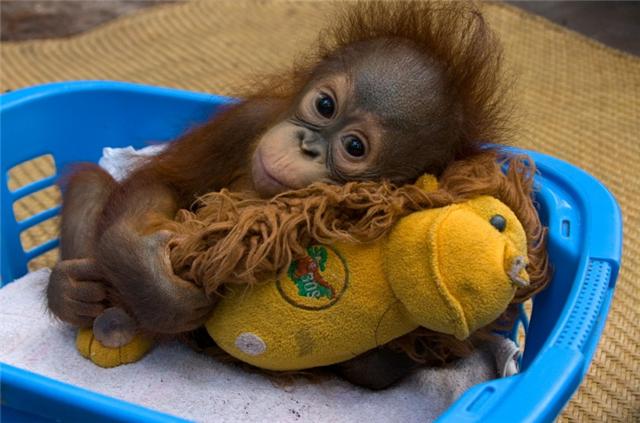 At night they sleep in a basket or in a big cage with their baby-sitter watching over them.
Most of these orangutans have been through traumatic experiences. They may have watched their own mothers being killed and as a result they sometimes experiences nightmares when sleeping. The baby-sitters are there to love, hug and care for them 24 hours a day until they manage to overcome their trauma.
Halfway House / Forest School
The halfway house is a playground forest for orangutans aged between 3 and 6 years old. They are free to play and explore the forest between the hours of 0700 and 1600.
The young orangutans are usually eager to learn how to explore the higher trees and try to make nests of their own, copying the skills of the older orangutans.
For safety reasons, they are then encouraged back to the big cage overnight although as they move through this stage and become more independent, many stay out in the forest at night.
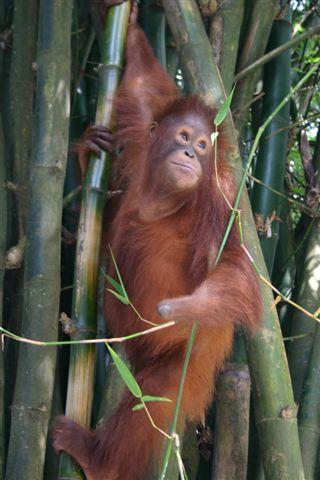 The orangutans are by nature motivated to find their own food and enrichment programs are in place to make this activity more challenging for them.
Orangutan University
The orangutans are then moved to lush river islands to refine their skills. They mostly go it alone without daily food provisioning or other intervention.
The orangutans will stay on the island for at least 2 dry seasons and one wet season to allow assessment of their readiness for full release.
Wild juvenile and adult orangutans are translocated to safe forest areas as quickly as possible after undergoing a complete health check.
To date these orangutans have been released in an area south of the Mawas Reserve but this is now at capacity.
Nyaru Menteng Orangutan Reintroduction Project
Rescue