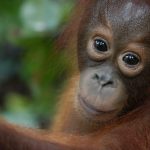

Lifeline for orangutans
Lifeline for orang utans
New Strait Times: 11 October 2009
WEAVING its way through the jungle, nibbling on fruits and tree bark, an orang utan suddenly finds itself in unfamiliar territory.
It looks ahead and sees row after row of oil palm, and soon starts foraging through this man-made landscape in search of another patch of forest for its next meal, and a tree to build a nest to sleep in.
This is the story of orang utans that move about in more than a hundred forest “islands” which mushroom from vast plantations at fertile flood plains on Sabah’s east coast.
An aerial survey last year discovered over a thousand nests were seen on tree tops in jungle fragments that ranged from a few hectares to a startling single tree.
The study became the basis for a two-day Orang Utan Conservation Colloquium on the outskirts of Kota Kinabalu aimed mainly at discussing the fate of the primate in fragmented ecosystems.
Dr Marc Ancrenaz of the French non-governmental organisation Hutan says the finding indicates orang utans are using plantations for short periods in their search for new territories and food.
“Between 2002 and 2007, there was a 30 per cent drop in the number of orang utans in the Lower Kinabatangan Wildlife Sanctuary but we didn’t find any dead ones.
“We started asking ourselves where these orang utans had gone, and we felt that they must have dispersed somewhere else.”
The 26,000-ha sanctuary gazetted four years ago is divided into 10 lots, which neighbour estates and several villages on the Kinabatangan flood plain.
Ancrenaz’s study done in collaboration with the Borneo Conservation Trust (BCT) and funded by the Malaysian Palm Oil Council (MPOC), found 200 nests in 25 forest islands in plantations in the Lower Kinabatangan area.
At plantations south of Sandakan, there were more than 200 nests in 10 forest patches and at yet, another location in the Sugud area, there were over 150 nests in 15 tiny tracts of jungle.
“Yes, orang utans can find food in plantations by eating palm fruit, but they can’t sustain themselves on a single plant. It is like telling a vegetarian to just eat carrots, and nothing else.
“It is unlikely that there can be a stable orang utan population in the long term in plantations. We have to find ways to reconnect the forests.”
A long-term result that factors in the crucial role of planters is what conservationists are pushing for, as it is clear that the palm oil industry is here to stay.
As the largest exporter of palm oil in the world, Malaysia raked in RM65.2 billion last year from this golden crop, making it the country’s third largest export contributor.
In Sabah, oil palm covers about 1.4 million hectares or about a third of the country’s total cultivation of 4.5 million hectares.
And then, there is another statistic: Sabah has 11,017 orang utans at last count, making it a stronghold as it shelters a fifth of its population in Borneo and Sumatra, and yet, 62 per cent live outside protected areas.
“There are two groups — the green people and the oil palm people. Each side wants to own what is left but if you want to get long-term results, we must sit together and talk.
“The important thing here is the fact that orang utans are getting isolated, and this affects gene flow which is needed for the long term survival of the species,” Ancrenaz says.
Genetic modelling carried out a couple of years ago showed a majority of isolated populations in the Kinabatangan area would be extinct in less than 50 years if nothing was done to reconnect the various groups.
Sabah Wildlife Department director Laurentius Ambu says inbreeding of the species will lead to extinction and is an urgent problem that needs to be solved quickly.
“This is why we are working with an NGO (Borneo Conservation Trust) to buy land from the locals at market value so that we can start reconnecting forests in the Lower Kinabatangan Wildlife Santuary.
“There are two lots in the fragmented sanctuary that are almost connected after BCT was able to buy the land. Planters have so far refused, but we are hoping that MPOC can come in to assist us.”
As the meeting progressed and it became clear that an overnight solution was not on the cards, the possibility of translocating orang utans in fragmented areas to forest reserves was raised.
The department’s chief veterinarian, Dr Sen Nathan says it could complement efforts to make sure orang utans in fragmented areas do not disappear, but it is not a solution.
“You have to look at the population of orang utans in the area marked for translocation. It is not that simple. There are issues of food sources and competition from other orang utans.
“Though the primate is solitary, it is territorial, especially the males,” Dr Nathan says.
The department translocated more than 550 orang utans in the last 18 years, but it was done when the primate was in a “life and death” situation such as during floods, or when an area was cleared for oil palm.
Apart from the fact that translocating one orang utan can cost up to RM10,000 and takes up to a week of already stretched manpower, no post release monitoring was done for those shifted from one area to another.
“This is being done now, but only for rehabilitated orang utans sent from the Sepilok Orang Utan Rehabilitation Centre to the Tabin Wildlife Reserve. In the case of wild orang utans, we moved them and just hoped they were able to survive.”
The human-orang utan conflict is not going to go away, and is one that needs answers now.
The six words on a framed photo of an orang utan given to Plantation Industries and Commodities Minister Tan Sri Bernard Dompok who opened the colloquium is perhaps reflective of the grave situation: “Will you still see me tomorrow?”