Orangutan Facts
‘Orang-hutan’ literally means ‘Man of the Forest’ and little wonder.
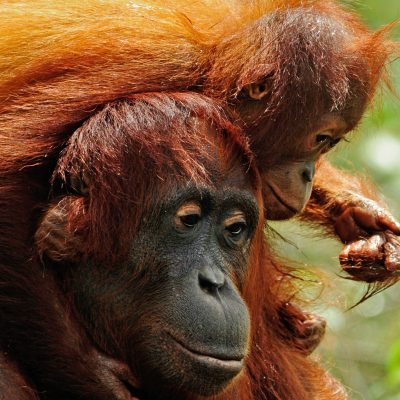
Orangutans are highly intelligent with an ability to reason and think. This large, gentle red ape is one of our closest relatives, sharing 98% of our DNA.
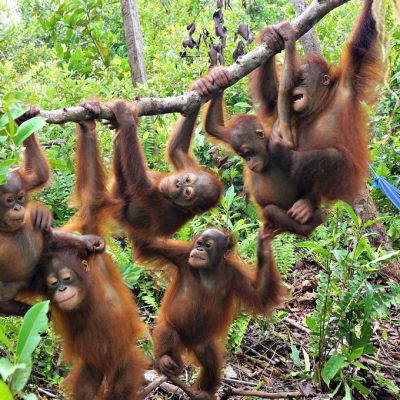
Orangutans are part of the great ape family, so they tend to be larger and heavier than monkeys, even though they are both primates. Great apes also have a bigger brain and can use tools, such as sticks, to help them get food to eat or leaves to make a sunshade or umbrella.
Orangutans live in Asia and are found on the islands of Borneo and Sumatra, living in lowland and hilly tropical rainforests. They are regarded as an ‘umbrella species’, which means they are pivotal in creating the necessary environment for the thousands of fauna and flora that make up the biodiversity of the South East Asian rainforest. Its arboreal tree-swinging journeys help to spread tree seeds – in fact, some trees can only germinate when they have passed through an orangutan’s gut.
There are three types of subspecies of orangutans found in Borneo:
- Pongo pygmaeus pygmaeus is the most endangered species of the Bornean orangutans with an estimated population of between 1,500 and 3,500 individuals. They are found in Western Kalimantan and also in Sarawak.
- Pongo pygmaeus morio is found in the North East around Sabah and East Kalimantan, with a population estimated between 8,000 and 18,000 individuals.
- Pongo pygmaeus wurmbii is the Central Kalimantan subspecies and the most plentiful with up to 40,000 individuals.
You can only tell the difference between these three subspecies by DNA testing.
At BOS, we have all three types in our care, so when returning them to the wild we must ensure they go to their endemic areas in Indonesian Borneo.
Bornean, Sumatran and Tapanuli Orangutans
| Common name | Scientific name | Population estimates | Status |
|---|---|---|---|
| Bornean Orangutan | Pongo pygmaeus | 57,350 | Critically Endangered |
| Sumatran Orangutan | Pongo abelii | 14,470 | Critically Endangered |
| Tapanuli Orangutan | Pongo tapanuliensis | < 800 | Critically Endangered |
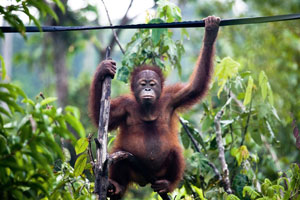

Bornean orangutan Sumatran orangutan
The Sumatran orangutan is smaller than its Bornean counterpart and has a longer face and lighter, longer coat. The newly discovered species of orangutan, the Tapanuli orangutan, has a smaller skull than the Bornean and Sumatran orangutans, but has larger canines. Mature males have cheek flanges similar to those of Bornean orangutans, but their slender build is more alike to Sumatran orangutans. Their hair is more cinnamon in colour than the Bornean species, and the Batang Toru population also makes longer calls than other orangutans.
The Great Ape Family
There are four members of the great ape family, of which orangutans are one. The members are as follows:
- Pongo – which includes the Bornean, Sumatran and Tapanuli orangutans
- Gorillas – including the eastern and western gorilla
- Pan – includes the common chimpanzee and the bonobo (also known as the pygmy chimpanzee)
- Homo – which includes modern humans and extinct relatives and ancestors such as the Neanderthal.
How Can You Help
There are lots of ways you can support orangutans and help ensure the survival of this precious ape.
Adopt an Orangutan
Orangutans are endangered and at risk of extinction. Habitat destruction results in hundreds of orphaned orangutans, who rely on our care every year. You can help by adopting one. Their dedicated ‘nannies’ teach them everything they need to know for when it’s time to release them back to the wild. You can follow their progress through Forest School.
Adopt Now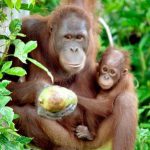
Make a Donation
Please help the Orangutans in their struggle for survival. Your donation is important and goes directly to BOS Indonesia. By donating, you are helping bring this noble yet endangered species back from the brink of extinction and on a path to freedom - from rescue to rehabilitation and release.
Donate Now
Visit Our Shop
The perfect gift for any occasion! Choose from our selection of instant gifts that directly support our orangutans. You can buy a wheelbarrow, provide food for an orangutan for two months or lots more. You will receive a certificate, personalised with the name of your choice - perfect gift for you or a friend.
Shop Now