Orangutan saviour supplies clean drinking water
Orangutan saviour supplies clean drinking water
Radio Netherlands Worldwide; Maarten Bakker* – 16 October 2008
Close to the city of Balikpapan on the Indonesian island of Kalimantan, it took conservationist Willie Smits just a few years to plant an entire new forest to create a sanctuary for threatened orangutans. The young forest now apparently generates so much rainwater that Smits is going to provide Balikpapan with clean drinking water. He hopes that if the city’s inhabitants realise their water supply depends on the forest, they will also leave it untouched and stop destroying the apes’ habitat.
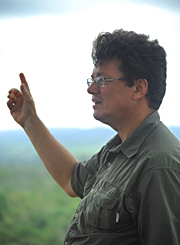 Willie Smits climbs an observation tower with three German visitors. He points proudly at the forest canopy covering the Samboja Lestari wildlife sanctuary. “Six years ago this was just grassland,” he says. The Germans have come to see the orangutans that Smits and his organisation, Borneo Orangutan Survival (BOS), take care of in Samboja Lestari.
Smits has become world famous for championing these apes, which are being driven out of Indonesia’s tropical forests as their habitat is eaten away by logging and palm oil plantations.
Climate change
Planting a considerable stretch of new forest inevitably has an effect on the local microclimate, and in this case it’s a favourable one.
“Yes, it sounds incredible, but we’ve really changed the climate here,” Smits explains. “We’ve planted 2000 hectares of mixed forest with 1040 different tree species, and our measurements show that after six years the cloud cover over Samboja Lestari has increased by 12 percent. The amount of rainfall last year actually came out at 25 percent more! The new forest cools the atmosphere, and that attracts rain clouds.”
Drinking water
The most important effect of the increased rainfall is that forest fires – an annually recurring plague in Indonesia – are no longer able to take hold in the moist landscape of Samboja Lestari. “Our forest protects itself from fires because it generates a lot of rain,” says Smits. And all that water in Samboja Lestari also turned out to make excellent drinking water. This gave Smits the idea of supplying water to the city of Balikpapan, 30 kilometres away from Samboja Lestari.
Economic heart
Because of the oil platforms off the coast, Balikpapan is the economic heart of Kalimantan. But if nothing is done, within five years the city will have no clean water supply. The seawater surrounding Balikpapan has leached into the fresh water reserves beneath the city.
The mayor therefore took little convincing of the value of Willie Smits’ water project. And Dutch water company WMD was also happy to offer its services. WMD already manages the water supply on the Mullucas and Sulawesi, and Willie Smits’ project made an attractive addition to its Indonesian activities. What’s more, the Dutch foreign ministry was prepared to subsidise the plan to the tune of 20 million euros.
Crystal clear
But how does the water get so clean? In fact, it’s very simple, says Smits – it more or less happens naturally.
“The forest does it, eh – we’ve built lots of very small dams so the water infiltrates the soil as much as possible. Then the roots and the leaf litter on the forest floor filter the water. It then slowly seeps into little streams and by then it’s nice clean water. If it were to flow quickly over the surface it would carry a huge amount of mud with it, and then it would be a lot more expensive to turn it into drinking water.”
After it has been purified using membrane techniques and ultraviolet light, the water will then be piped to the city.
Permanent habitat for orangutans
Smits says ultimately the orangutans will also benefit from his drinking water project, because the water will create an excellent reason to leave the forest alone. Smits has tried everything to save Indonesia’s tropical rainforest, the habitat of the orangutans. He has patrolled the forest, and even fired nails into the trees to break the chainsaws of illegal loggers, but to no avail. Smits now hopes that if the local people realise they depend on the forest for their drinking water, they’ll stop cutting it down.
*RNW translation (mb)