Orangutans Rescue and Release Operation 17-27 Jan 2012
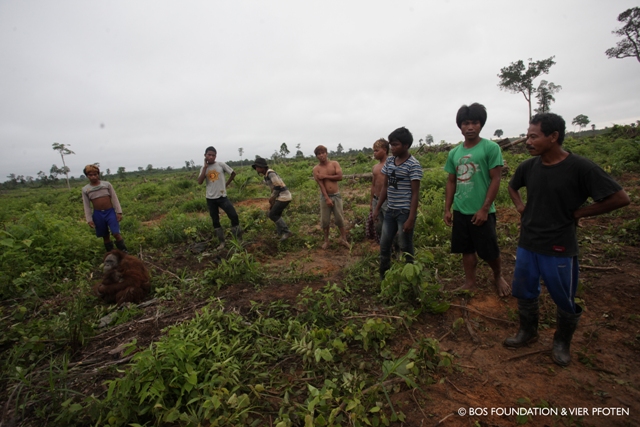
A mother and baby orangutan were rescued from hunters in what used to be their rainforest home, but is now a cleared barren plain ready to become a palm oil plantation.
The Rescue Team, consisting of Borneo Orangutan Survival Foundation (BOSF) and the Office of Conservation and Natural Resources saved these two orangutans from the hunters surrounding them.
A day earlier, the Rescue Team had been combing the area, but only found a few orangutan nests estimated to have been built two or three days before.
The next day, they received an anonymous tip about a group chasing two orangutans in the area since the night before.
The Rescue Team arrived just in time!
A group, armed with machetes, knives and ropes, were about to catch the two orangutans. Once they spotted the Rescue Team accompanied by Conservation Office officials, they immediately let go of their weapons, allowing the team to conduct the rescue.
The mother orangutan, estimated to be 25 years old, gave no resistance when the vet and technicians approached and sedated her, she just hugged her little daughter protectively. This behavior is contrary to that of a wild orangutan, suggesting she was utterly exhausted after being chased throughout the night.
According to an informant, the poachers were not local residents. They seemed pleased when the team arrived and even helped save the orangutans. When the team thanked them and walked away without giving anything in return, their faces changed. It was clear that they expected something from the rescue.
Some palm oil companies see orangutans as pests – a threat to their lucrative business, and place a bounty on their heads. It’s been reported that some company executives offer just A$150 for each animal killed.
While stories like this were at first denied, proof of the slaughter emerged last September, when investigators found the graves and bones of massacred orangutans.
When the vet performed a health check, he discovered the mother was about three months pregnant. They were named Suci (mother) and Sri (daughter) and were given a clean bill of health. To make sure they adapt to their new home in the safety of Kehje Sewen Forest, they had identity chips implanted, with Mum also fitted out with a radio transmitter for ongoing monitoring.
Suci and Sri were taken to Kehje Sewen by road, an arduous journey, with the team stopping regularly to check on their charges. To access Kehje Sewen, the team travelled through harsh conditions and encountered many obstacles. The tracks were badly damaged, slippery and muddy, there were landslides, broken bridges and several rivers to be crossed. Due to these conditions, the team decided to bring Suci and Sri to their release point in the forest on a stretcher – it would have been impossible to carry them in cages.
In the forest, Suci and Sri woke up from anesthesia and after a recovery period began climbing up into the trees. They looked carefree and happy, swinging among branches.
The rescue and release operation was completely successful.
This activity was initiated and made possible from the goodwill of East Kalimantan provincial government, consisting of BOSF, RHOI and BKSDA EastKal with oil palm companies in East Kalimantan that belong to the Indonesian Palm Oil Association.
Rescue and release operations are not without consequences.
Releasing wild orangutans in Kehje Sewen Forest has resulted in reducing the land area originally prepared for rehabilitated orangutans. We require more land for orangutans and have applied for permits for additional lands in East and Central Kalimantan. The process seems to run into various obstacles and Government support is needed to accelerate the process.
The private sector, especially companies and oil palm plantations have a great responsibility in orangutan conservation efforts. The biggest challenge is to make them aware and get serious commitment.
Orangutan populations have dropped dramatically in recent times, and are on the verge of extinction. Saving wild orangutans from potential conflict with humans is only a short-term solution. Commitment and involvement from all parties, especially the private sector, whose businesses intersect with their presence, is necessary to enforce the law and conserve the orangutans.
The good news is that the release site was the Kehje Sewen site which was funded by Australian BOS donors including a significant contribution by John Cochrane.
View the official release video.