

Palm oil threat to Indonesia’s orangutans
BBC: 27 December 2011: Karishma Vaswani BBC News, East Kalimantan
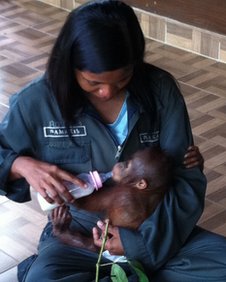
Rosa cares for baby orangutan Elaine at Samboja
Lestari sanctuary
Eight-month-old baby orangutan Elaine would have never survived without her carer Rosa.
Coaxing the infant ape to eat, Rosa uses a mixture of baby-talk orangutan sounds, trying to mimic the noises Elaine’s mum would have made if she were here.
The baby orangutan and her mother were separated when they were chased off a palm oil plantation by some workers. It is not clear whether the older orangutan is even alive.
Now, Elaine depends on Rosa for care.
“She usually cries when I leave,” Rosa said, cradling the baby ape. “So I need to always be close to her.”
Elaine is one of two baby orangutans rescued from palm oil plantations in the last few months and brought to the Samboja Lestari sanctuary in East Kalimantan.
Orangutans are very vulnerable when they first arrive at the sanctuary, explained Ascheta Bastuni Tajuddin, the manager of Samboja Lestari.
“The two babies Elaine and Mads, they were really stressed,” she said. ”One had diarrhoea, and the other had fever.”
”Most of the orangutans we have here are confiscated from people’s houses,” she added. ”But lately, there are several baby orangutans that we have rescued who have been separated from their mothers.
”Either the mother is killed or runs away because of the people chasing her on palm oil plantations.”
Chased and killed
Unfortunately, Elaine and Mads are not unique cases. There have been a number of reports of late of orangutans being chased away on palm oil plantations in East Kalimantan. At least 750 are thought to have been killed during 2008 and 2009.
Orangutans, amongst the most endangered species in Indonesia, are increasingly under threat in their own homes.
In the last few weeks, Indonesian police have arrested five palm oil plantation workers on suspicion of killing the great apes, bringing the total number of those arrested to nine.
On the bumpy car ride to the area in East Kalimantan where many of the killings are thought to have taken place, it was apparent that much of the landscape had been converted into palm oil plantations.
“Just 10 years ago, this was all forest,” Rudi, who drove the BBC team to the sanctuary, said. “These areas used to be the homes of the orangutans until the palm oil plantations came.”
Forests are the natural habitats of Indonesia’s orangutans. But the expansion of palm oil plantations and coal mines in East Kalimantan’s forest areas has resulted in tragic consequences for the animals.
”When the orangutans came back to the areas they once thought were their homes, they were driven out by the people who work on these plantations,” Rudi said.
Dire consequences
At a plantation where some killings have been reported recently, workers chopping away leaves of the oil palm trees, to get to the bright orange fruit hidden beneath were reluctant to speak to the BBC.
The precious palm oil comes from inside this fruit. Oil is extracted both from the pulp and the kernel of the fruit.
Finally Ronal from Sulawesi said that he knew about the orangutan deaths and the reasons why some workers were willing to hurt them.
“Some workers found an orangutan on the plantation,” he said. “The company paid them $100 (£64) for it. I don’t know what the company did with the ape, but they want them gone because they see them as pests.”
Palm oil firms say they are innocent and that conservation groups blame them unfairly. But environmentalists say there are dire consequences if nothing is done to stop the killings of orangutans.
“They will go extinct in the wild in perhaps five years,” said Arfiana Khairunnisa, with the Centre for Orangutan Protection in East Kalimantan.
”We find this case only in plantation areas they are considered as pests actually by the workers because they eat the palm seedlings,” she added. ”Orangutans are protected by law in Indonesia so this violates the law.”
Indonesia is home to 90% of the world’s orangutans.
The Indonesian government has said it is committed to protecting orangutans, but critics have questioned why palm oil plantations are being allowed to expand in their natural habitat.
On the journey out of the plantation area, driver Rudi stepped on the brakes suddenly, bringing the car to an abrupt halt.
“Look! There on the road! An orangutan!” he exclaimed.
The orangutan lumbered slowly across the dirt road, one giant arm swinging against the other. He paused, as if startled by something he heard, and proceeded to scamper quickly off into the forest.
He moved too fast for a photograph to be taken. It was very rare to see an orangutan in the wild, said Mike, the BBC’s guide from the Centre of Orangutan Protection.
“Unfortunately, he might not be so lucky,” he added. ”This is very near the area where many of the killings of orangutans have been reported. He could be the next victim.”