
Time is running out for Sumatra’s rainforest
‘Time is Running Out’ for Sumatra’s Rainforest as Demand for Palm Oil Soars
Jakarta Globe: 6 December: Arwa Damon
Photo: Reuters
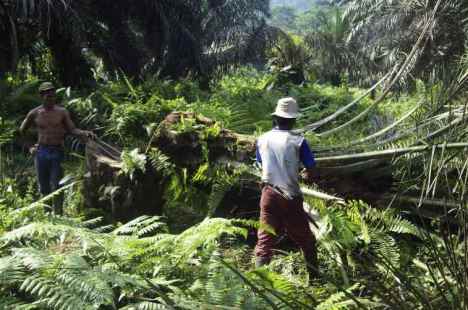 Driving through Indonesia’s central Sumatra, it appears that all life on earth has been obliterated, like a scene from some apocalyptic movie.
The land is tinted a sick gray. Some parts still smolder. Twisted hulks of tree trunks take on abnormal shapes. It is nearly impossible to imagine that this was once lush tropical rainforest.
Nearby the rolling hills are covered in a sea of emerald green. But it is not a natural forest — it is a palm plantation.
In supermarkets worldwide products containing palm oil — soaps, chocolates, margarine and cosmetics — fly off the shelves. Most consumers have no idea these products contain palm oil, often labeled as vegetable oil, and even less of a clue that conservationists are singling it out as being one of the main driving forces behind deforestation.
Clearing forests for agriculture isn’t exactly new, but palm is quickly becoming the crop of choice. It is fast growing with high yields, global demand now tops 40 million tons a year, and it’s central to the economies of Malaysia and Indonesia.
But the rate at which Indonesia’s natural forests are being torn down has made this tropical nation one of the world’s largest contributors to greenhouse gas emissions. Already, 85 percent of Sumatra’s forests are gone and what is left is disappearing at an alarming rate.
“We are running out of time here. We are at the end of the tunnel,” Peter Pratje, of the Frankfurt Zoological Society, said at an orangutan sanctuary in the heart of Sumatra. Sumatran orangutans are expected to be the first great ape to go extinct — due to the loss of their natural habitat.
“The problem is there is no second chance,” Pratje adds. “If you shut down an ecosystem that is hundreds of years old you can’t regrow it.”
It is a reality that even the largest buyers and producers of palm oil acknowledge. Consumer products giant Unilever spearheaded a movement towards sustainable palm oil cultivation — the Roundtable on Sustainable Palm Oil — which gathered palm producers, manufacturers and green groups to seek out a sustainable way to cultivate palm.
“If agriculture cannot be made sustainable then we as a food and home and personal care company are in trouble,” Unilever Jan Kees Vis explained.
But critics like Greenpeace fault the RSPO’s standards for being too weak and say that they cannot control their members.
“If a company is doing deforestation and peat land destruction, we cannot say the company is sustainable,” said Greenpeace activist Bustar Maitar.
At the moment, only 3 percent to 4 percent of globally produced palm oil is certified by the RSPO. It is a drop in the bucket now, but the RSPO expects the volume to double in the next year.
But that probably will not be enough to save Sumatra’s forests. Conservationists say that it is time for companies to control their desire for more money, governments to start seriously enforcing forest protection laws and individuals consumers to take on responsibility and make lifestyle changes.
For Sumatra, it might already be too late.
Arwa Damon is an international correspondent for CNN.