AGIS BRINGS EXCITING NEWS
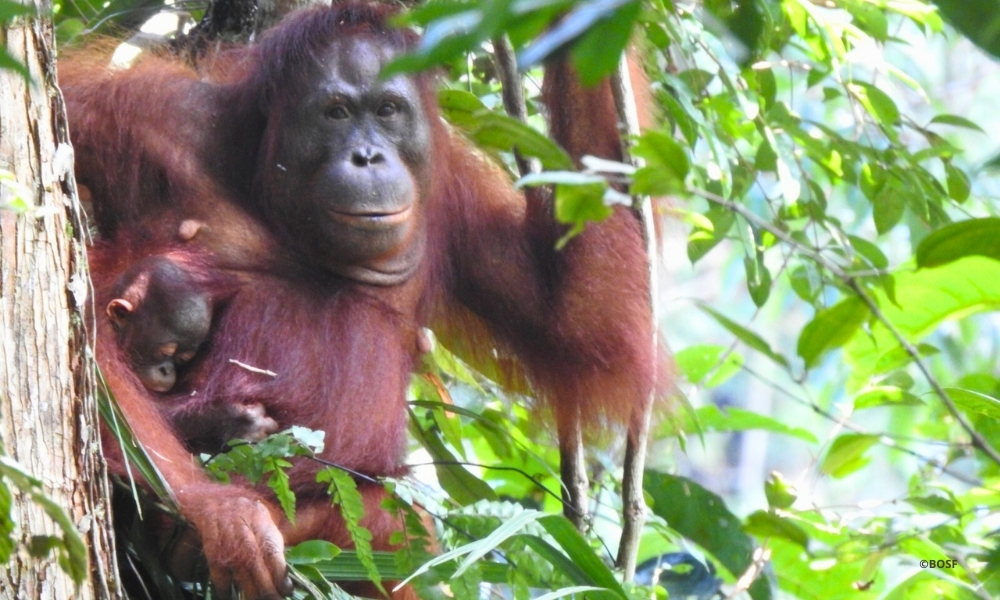
Our efforts to monitor orangutans in the wild have once again delivered heartening news. BOS Foundation’s Post-Release Monitoring (PRM) Team recently encountered a female orangutan strongly believed to be Agis. The rehabilitated female, released into Bukit Baka Bukit Raya National Park (TNBBBR) in 2018, had a beautiful surprise for the rangers.
The encounter occurred while the PRM Team was conducting a Radio Tracking (RT) expedition to locate and check orangutan signals in the Sepan Suping area, within the Bemban Watershed. Initially, the team detected a signal from an orangutan named Kejora and immediately moved toward the location.
However, upon arrival, the orangutan observed was not Kejora. Instead, the team encountered another female whose radar signal they could not detect. Further checks confirmed that her transmitter was no longer active.
Identification Points to Agis
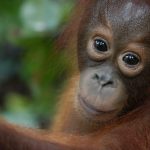
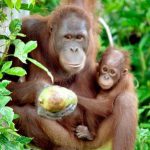
To confirm the orangutan’s identity, the team conducted a more detailed analysis of her facial features and physical characteristics. The observations strongly suggest that the female was Agis, whom the BOS team released into the TNBBBR area in early 2018. The big surprise: Agis was carrying an infant estimated to be around 6 to 8 months old. The baby is most likely her first offspring born in the wild, and for ease of reference and documentation, it has been named Agus.
The finding is particularly exciting because Agis had not been seen for a long time. Her reappearance in good condition, especially while caring for an infant, is an important indicator of the success of our orangutan rehabilitation and release program.
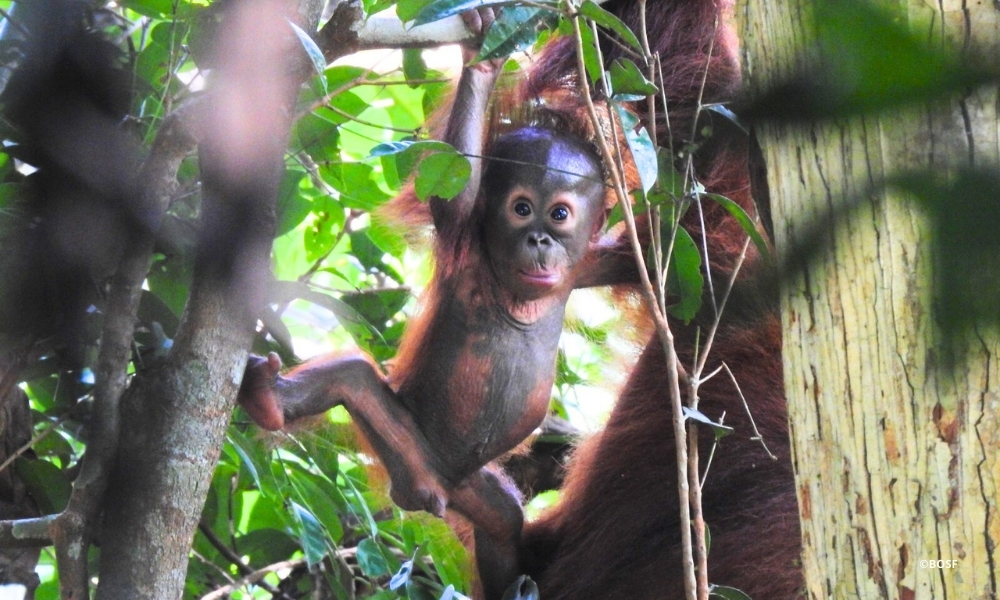
Baby Agus is about 6 to 8 months old, and most likely Agis’s first wild-born offspring.
Tracing Agis’s Long Journey
Agis was first rescued on 22 April 2006 by a joint rescue team from the Central Kalimantan Natural Resources Conservation Agency and the BOS Foundation. At the time, a resident of Kuala Pembuang, Seruyan Regency, Central Kalimantan, had kept her as a pet and treated her like a human child for approximately 7 months.
When she arrived at the rehabilitation centre, Agis was only 2.5 years old, weighed 6.6 kilograms, and was suffering from dehydration and malnutrition. She underwent a quarantine period before joining Forest School, where she learned essential survival skills.
After graduating from Forest School, Agis continued to the pre-release stage on Bangamat Island in 2014, before being transferred to Kaja Island in 2015. Throughout this process, she proved herself as an adaptable individual who socialised well with other orangutans. She displayed a gentle temperament, yet was capable of defending herself when competing with others during rehabilitation.
A Living Proof of Rehabilitation Success
Now approximately 21 years old, Agis has been living independently in the forests of TNBBBR, equipped with the survival skills needed to thrive in the wild. Her reappearance during monitoring activities, together with the infant she is raising on her own, stands as tangible proof that rehabilitated orangutans can successfully adapt, reproduce, and embrace a second chance at life in their natural habitat.
The encounter with Agis and Agus is not only a significant moment for our team, but also a powerful reminder that every long and challenging rehabilitation and release process has a tangible impact on the conservation of orangutans and the forests of Kalimantan.
We hope that Agis and her offspring will continue to grow strong and healthy, becoming part of a new generation of orangutans in Bukit Baka Bukit Raya National Park.